
Design Your Next Decade of Wellness and Wellbeing


If nothing changed, would you want to live the life you’re currently building?
Most people drift into the next decade. They don’t design it. They carry forward the same habits, the same sleep debt, the same stress patterns, the same excuses, and then act surprised when their body, energy, or joy starts pushing back.
Here’s a confronting question worth sitting with:
If you kept living exactly as you are now, would you be proud of where your health and wellbeing land ten years from today?
Because whether you realise it or not, you are already designing your next decade, just not consciously.
Most people plan careers. Few plan bodies, energy, or peace.
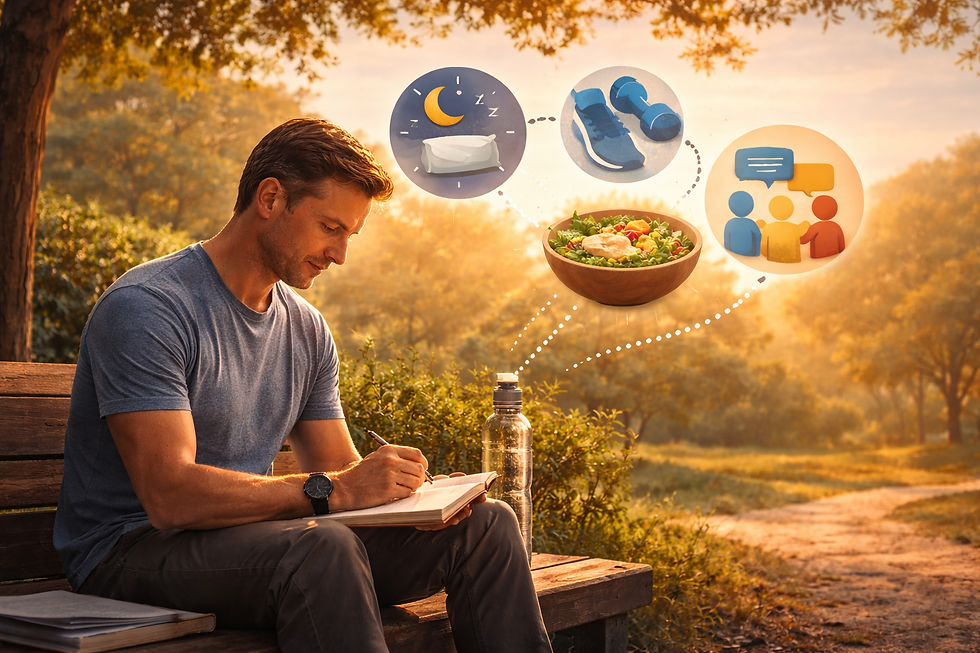
We plan finances. We plan careers. We plan holidays. But we rarely plan:
What kind of energy we want at 55
What kind of body we want to live in at 60
What kind of emotional stability we want under pressure
What kind of presence we want to bring to our families
So instead, we default to reaction mode, fixing problems when they become unavoidable. Designing your next decade flips that script.
A real-world example: the quiet fork in the road
I often work with high-performing professionals in their late 30s, 40s and 50s. Two people. Same job level. Similar workload and work lifestyle.

One says:
“I work so hard, I want to enjoy what I can get. I will deal with my health once things calm down. Life is too short.”
The other says:
“I want to be strong, well, clear-minded, and more intentional ten years from now. Help me make shifts now.”
Five years later, the difference is stark:
One is managing illness, medications, injuries, and burnout, relationship breakdowns, brokenness with children.
The other has momentum, resilience, and margin
The gap didn’t come from dramatic change. It came from directional clarity.
Designing the future starts with imagination, not effort
Before tactics, before habits, before routines, there’s a deeper question:
Who do I want to be in the decade ahead?
Not just professionally, but physically, emotionally, spiritually.
Scripture invites this kind of forward-looking wisdom:
“Where there is no vision, the people perish.” Proverbs 29:18 (NKJV)
Vision isn’t wishful thinking. It’s a form of alignment, choosing a destination so today’s decisions make sense.
And Jesus Himself framed life this way:
“Which of you, intending to build a tower, does not sit down first and count the cost…?” Luke 14:28 (NKJV)
Design precedes building. The science of intention backs this up. Modern psychology reinforces this ancient wisdom:
Research on future self-continuity shows that people who vividly imagine their future selves make healthier choices today (Hershfield et al., 2021).
Behavioural studies confirm that people who anchor habits to a clear long-term identity, not short-term goals, are more consistent and resilient (Milkman et al., 2022).
When the future feels real, present choices change.

A simple way to start designing your next decade
Try this thought exercise:
How do you want to feel most days in ten years?
What do you want your body to enable, not restrict?
What kind of stress do you want to tolerate, and what kind do you want gone?
What rhythms of rest, movement, nourishment, and connection would support that life?
Then ask:
What am I doing today that clearly leads there, and what clearly doesn’t?
No guilt. No drama. Just honesty.
Steward the life you have been entrusted with.
The next decade won’t arrive all at once. It will arrive one ordinary day at a time. You don’t need a total life overhaul. You need a clear picture of where you’re heading, so today’s choices stop being random. Design first. Build daily. Steward the life you’ve been entrusted with. Because what you don’t design intentionally, you’ll inherit by default.

References:
Gallup. (2023). State of the Global Workplace 2023. https://www.gallup.com
Hershfield, H. E., et al. (2021). Increasing saving behavior through age-progressed renderings of the future self. Journal of Marketing Research, 58(2), 307–324. https://doi.org/10.1177/0022243720983919
Milkman, K. L., et al. (2022). Identity-based habits: How identity cues increase exercise persistence. Behavioural Science & Policy, 8(1), 41–53.
Singh-Manoux, A., et al. (2021). Timing of onset of cardiovascular risk factors and cognitive decline. BMJ, 372, n348. https://doi.org/10.1136/bmj.n348
Waldinger, R. J., & Schulz, M. S. (2023). The good life: Lessons from the world’s longest scientific study of happiness. Simon & Schuster.
World Health Organization. (2023). Noncommunicable diseases progress monitor. https://www.who.int


Comments